
 USB-C
USB-CThe USB-C plug
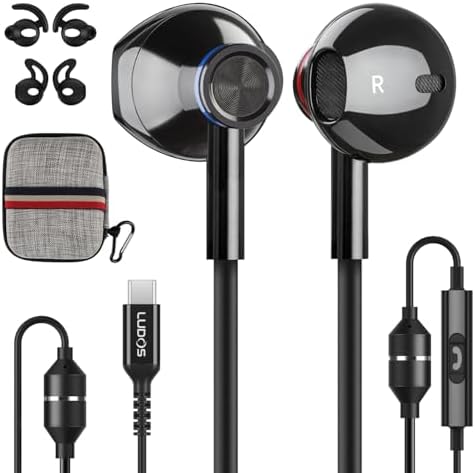
When the round hole left phones, the charging port had to carry sound as well. These are the pairs built to plug straight into it, with no adapter in the middle.


A catalog built around the wire
- 7listings on this shelf
- 63color codes behind them
- $9.99is where this shelf starts
- 10,333votes across the shelf
Why the round hole left phones
A phone is a fight for millimeters. The round socket is deep, it needs a sealed barrel through the case, and it does one job. A maker who removes it gets back internal volume for battery and gets one fewer opening to weatherproof.
Whatever you think of that trade, it happened, and by now a whole generation of handsets ships with one port on the bottom edge. Our answer is to put the plug on the end of the cable rather than to make you carry it separately.
There is a small piece of electronics in the plug
USB-C hands over a stream of numbers, not a finished signal, so something has to turn those numbers into movement. On these pairs that something lives in the plug housing itself, which is why the plug is a little longer than a round one and why it draws a trickle of power from the device.
Practically, it means the device does not need anything built in. It also means the pair is doing the conversion the same way every time, on a phone, on a tablet and on a laptop, rather than inheriting whatever each one happens to have inside.
What it will not do
It will not go into the flat rectangular port on an older laptop. It will not go into the round hole, either, so a household with both kinds of device wants both kinds of cable rather than one and an adapter drawer.
And while the pair is plugged in, the port it is using is the port you charge through. For a train journey that is fine. For a long evening it is the one real thing you give up, and we would rather say so here than let you find out at eleven at night.
Our named lines
Choose the plug that matches your port, then choose the shape you want. The line decides the housing metal, the cord braid and the button setup under your thumb.
Workbench articles
Which plug your phone takes
One look at the bottom edge of the phone settles which of our pairs will work. Here is what changed, what an adapter costs you, and why laptops are a different story.
Keep readingGetting a seal with ear tips
Sound that came out thin and tinny is almost never a broken driver. It is a tip that never closed the ear canal. How to seat foam properly and when to swap.
Keep readingHow a wired pair stays quiet
No circuit, no battery, no cancellation. Just a foam tip filling the canal. What that blocks well, what it will not touch, and why we left the battery out.
Keep reading
What is your jack?
Two questions. The first is about the socket you plug into, because that rules more pairs in and out than anything else here. The second is about what you are actually doing while you wear them, because that is what each line was built around.